

The gap between a contained security incident and a catastrophic breach is almost never determined by whether the attack succeeded in gaining initial access. It is determined by what happens in the hours and days after that initial access: how quickly the intrusion is detected, how effectively the response limits the attacker’s movement, and whether the organization had the capability and the plan to execute a disciplined containment and recovery before the damage reached its full potential.
For Boca Raton businesses in financial services, healthcare, and professional services where the stakes of a significant breach include regulatory consequences, client relationship damage, and operational disruption that can persist for weeks, the difference between a fast, effective incident response and a slow, improvised one is measured in outcomes that are orders of magnitude apart.
Security operations and incident response capability are what determine which outcome a business experiences when an attack succeeds.
Why Dwell Time Is the Critical Security Metric
Dwell time, the period between an attacker’s initial successful access and the point at which that access is detected, is the most consequential security metric for understanding how bad a breach will ultimately be. Every hour of undetected dwell time is an hour in which an attacker can move laterally to additional systems, escalate privileges to higher-access accounts, identify and stage sensitive data for exfiltration, establish persistence mechanisms that survive initial remediation, and deploy ransomware payloads at the moment of their choosing.
The IBM Cost of a Data Breach Report has consistently found that breaches with longer dwell times produce significantly higher total costs than those detected and contained quickly. Organizations that detect and contain a breach within 200 days typically incur significantly lower total costs than those where the breach runs longer, reflecting both the scope of damage that accumulates during extended dwell times and the complexity of the recovery that follows.
For Boca Raton businesses, the dwell time picture reflects the monitoring capability in place. Organizations with continuous security operations monitoring that correlates signals across endpoint, network, identity, and application telemetry detect intrusions significantly earlier than those relying on periodic log reviews and reactive alert response. The difference in detection time translates directly into a difference in breach scope and cost.
The Security Operations Center: What It Does and Why It Matters
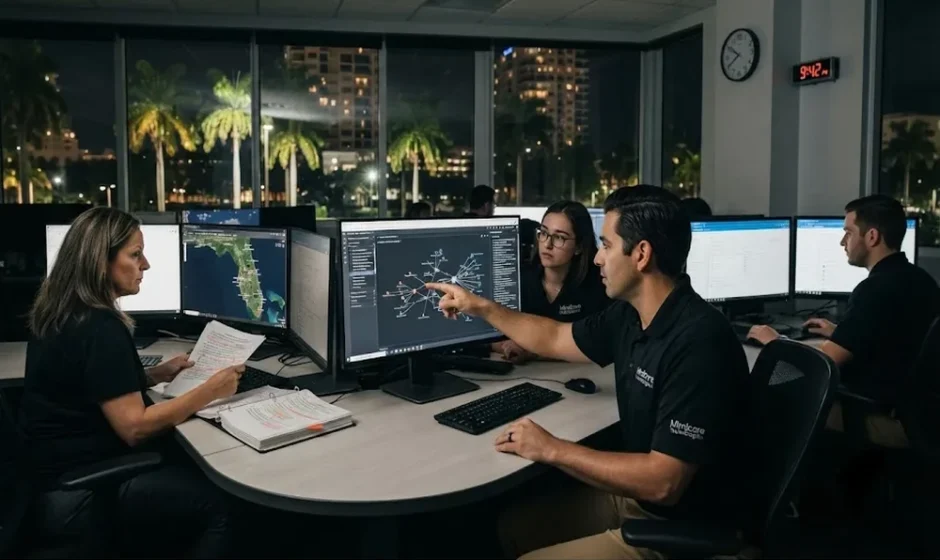
A security operations center is the organizational and technological capability that enables continuous monitoring, threat detection, alert triage, and incident response coordination for an environment. It combines the technology stack that generates and correlates security telemetry with the human expertise that interprets that telemetry and makes the response decisions that automated systems cannot.
The core technology components of a modern SOC include a security information and event management platform that collects, normalizes, and correlates log and event data from across the environment, an endpoint detection and response platform that provides behavioral monitoring and response capability at the device level, a threat intelligence feed that contextualizes observed activity against current adversary techniques and active campaigns, and increasingly an extended detection and response platform that integrates visibility across endpoint, network, identity, and cloud telemetry in a unified interface.
The human components that give these technologies their operational value include the security analysts who investigate and triage alerts, distinguishing genuine threats from false positives and escalating confirmed threats through the appropriate response chain. The threat hunters who proactively search for evidence of compromise that automated detection has not surfaced. The incident commanders who coordinate response activities across technical teams, communication functions, and executive leadership during significant incidents. And the threat intelligence analysts who maintain current understanding of the adversary techniques, campaigns, and indicators of compromise most relevant to the organization’s specific risk profile.
For Boca Raton businesses without the scale to build and staff an internal SOC, managed security service providers who deliver SOC capabilities as a service provide access to this operational infrastructure at a cost model appropriate for organizations that are significant enough to require the capability but not large enough to justify building it entirely internally.
Incident Response Planning: The Foundation That SOC Depends On
Security operations monitoring provides the detection capability that initiates an incident response. The quality of that response is determined by the planning and preparation that preceded it. An organization with excellent detection capability and no incident response plan will detect intrusions faster than it can contain them because the response is improvised under conditions of uncertainty and time pressure that are not conducive to good decision-making.
Incident response planning for Boca Raton businesses must address several specific elements that the local regulatory environment makes mandatory rather than optional.
Notification timelines are the most acute incident response requirement for regulated businesses. The SEC’s cybersecurity disclosure rules require registered entities to file Form 8-K disclosing material cybersecurity incidents within four business days of determining materiality. HIPAA requires covered entities to notify affected individuals within 60 days of discovering a breach involving protected health information, with notification to HHS and potentially the media for breaches affecting 500 or more individuals in a state. Florida’s data breach notification statute requires notification to affected Florida residents expeditiously and without unreasonable delay, with a 30-day notification deadline that has been a consideration in state enforcement actions.
Meeting these notification timelines requires an incident response plan that identifies the notification obligations triggered by different types of incidents, the decision criteria for determining materiality under the SEC framework, the responsible parties for executing notifications, and the legal and communications resources required to support those notifications. Organizations that build this framework before an incident can meet regulatory timelines. Those that figure it out during an incident consistently struggle.
Containment procedures that limit lateral movement and data exfiltration during an active incident require pre-defined playbooks that incident responders can execute consistently under pressure. A network isolation procedure for a compromised endpoint that is documented, tested, and practiced can be executed in minutes. The same procedure improvised during an active incident while an attacker continues to move through the environment takes significantly longer and produces inconsistent results.
Evidence preservation requirements that protect forensic data needed for regulatory reporting, law enforcement cooperation, and legal proceedings must be built into the initial response procedures rather than addressed as a secondary concern after containment. Evidence that is overwritten during a rushed remediation process cannot be recovered, and its absence creates complications for subsequent regulatory and legal proceedings that are avoidable with appropriate initial response discipline.
Microsoft Sentinel and MXDR for Boca Raton Financial and Healthcare Organizations
The Microsoft security ecosystem provides several capabilities that are particularly relevant for Boca Raton businesses already operating within the Microsoft 365 and Azure environments that are standard across the financial services and healthcare sectors.
Microsoft Sentinel, Microsoft’s cloud-native SIEM and security orchestration platform, provides the log aggregation, correlation, threat detection, and investigation capability that forms the analytical backbone of modern SOC operations. Its native integration with Microsoft 365 Defender, Microsoft Defender for Endpoint, Microsoft Entra ID, and Azure Security Center provides unified visibility across the identity, endpoint, email, and cloud security telemetry that Boca Raton organizations generate across their Microsoft-centric environments.
The threat detection rules and analytics available in Sentinel, including the MITRE ATT&CK framework-mapped detection rules that identify specific adversary techniques rather than just generic anomalies, provide the structured detection coverage that helps SOC analysts prioritize the alerts most likely to represent genuine threats in the context of the techniques being used against organizations in the specific sectors that define the Boca Raton market.
Microsoft’s Managed Extended Detection and Response service, MXDR, extends Sentinel’s detection capability with Microsoft’s own threat intelligence and security operations expertise, providing a managed overlay that augments internal security teams with Microsoft specialists who monitor for and respond to threats across the customer’s environment. For Boca Raton financial and healthcare organizations that want the detection depth of the Microsoft security stack with managed response capability, MXDR represents an integration of technology and operations that avoids the build-it-yourself complexity of an internal SOC.
The Tabletop Exercise: Testing Response Before the Real Thing
The most consistent finding from post-incident reviews of organizations that experienced significant breaches is that the incident response plan existed but had never been tested against a realistic scenario. Plans that look complete on paper consistently reveal gaps and coordination failures when they are first exercised under realistic conditions, and discovering those gaps for the first time during an actual incident is the most expensive way to find them.
Tabletop exercises that walk incident response teams through realistic attack scenarios, requiring them to make the decisions they would face during an actual incident in the sequence those decisions would occur, reveal the gaps in plans before those gaps have consequences. Who makes the materiality determination that triggers SEC notification? What is the criteria? Who is in the notification chain when a suspected breach is identified outside of business hours? What is the procedure if the primary incident commander is unavailable? What external resources have been engaged before the incident, and how quickly can they be activated?
For Boca Raton businesses in regulated sectors where response failures create regulatory exposure alongside operational damage, tabletop exercises are not a periodic compliance checkbox. They are a recurring investment in the response capability that protects the business when detection capability successfully identifies the attacks that will inevitably occur.
How Mindcore Technologies Delivers Security Operations and Incident Response for Boca Raton
Mindcore Technologies brings more than 30 years of cybersecurity and IT operations experience to the security operations and incident response requirements of Boca Raton’s financial, healthcare, and professional services organizations. Under the leadership of Matt Rosenthal, CEO of Mindcore Technologies, the company delivers cybersecurity services in Boca Raton that include security operations monitoring, SIEM implementation and management, incident response planning and testing, and the 24/7 response capability that Boca Raton businesses need to match the continuous operational tempo of the threats targeting their sectors.
Mindcore’s security operations programs are built around the specific regulatory notification requirements, the specific adversary techniques most active against the Boca Raton market, and the specific technology environments that their clients operate. Their incident response planning engagements produce frameworks that are immediately usable rather than requiring translation from generic templates, and their tabletop exercise programs test those frameworks against scenarios drawn from actual incidents affecting organizations in the same industries as their Boca Raton clients.
Conclusion
The security incidents that produce the most devastating outcomes for Boca Raton businesses are not necessarily the most sophisticated attacks. They are the attacks that ran longest before detection and were responded to least effectively when discovered. Security operations and incident response capability directly address both of these variables, providing the continuous monitoring that minimizes dwell time and the tested planning that makes the response fast and effective when detection succeeds.
With Mindcore Technologies and more than 30 years of cybersecurity expertise, the security operations and incident response capability that Boca Raton businesses need is available as a structured, well-supported program rather than a capability that must be built from scratch under the pressure of an incident that has already begun.
About the Author
Matt Rosenthal is the CEO and President of Mindcore Technologies, a full-service IT consulting and cybersecurity firm serving businesses across Florida, New Jersey, Maryland, South Carolina, Louisiana, Texas, and nationwide.
With more than 30 years of experience in enterprise cybersecurity, security operations, and incident response program development, Matt has helped organizations across financial services, healthcare, and professional services build the detection and response capabilities that determine breach outcomes. He holds an MBA in Technology Management, is a certified Project Management Professional (PMP), and is the host of Digging In, a weekly podcast on success in business, life, and health.