

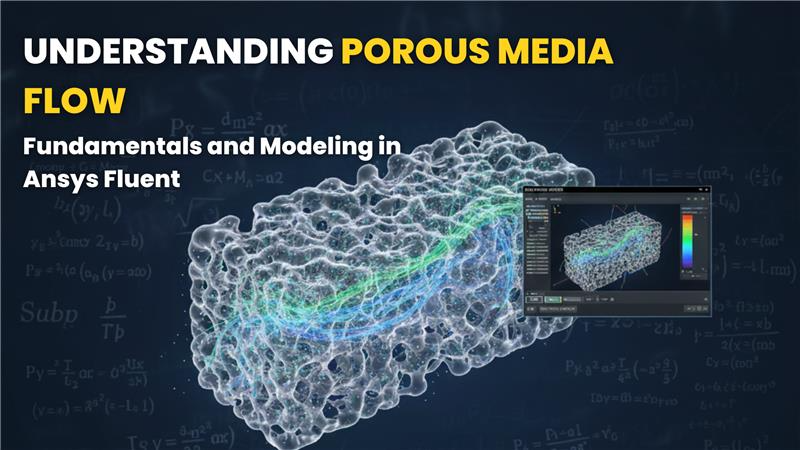
Porous media flow refers to the motion of fluids through materials, mainly through the interconnected pores. Predicting this behaviour of the fluid is very important for safety, efficacy & sustainability purposes.
Modern simulation tools, such as Ansys Fluent, have revolutionised how engineers study porous media. It offers flexibility, precision & real-time insights.
According to research, over 35% of industrial filtration systems rely solely on accurate modelling of porous flow to enhance efficiency and reduce costs.
For professionals, mastering this area through Ansys Fluent training or a structured Ansys Fluent online course is key to unlocking advanced modeling capabilities.
What is Porous Media Flow?
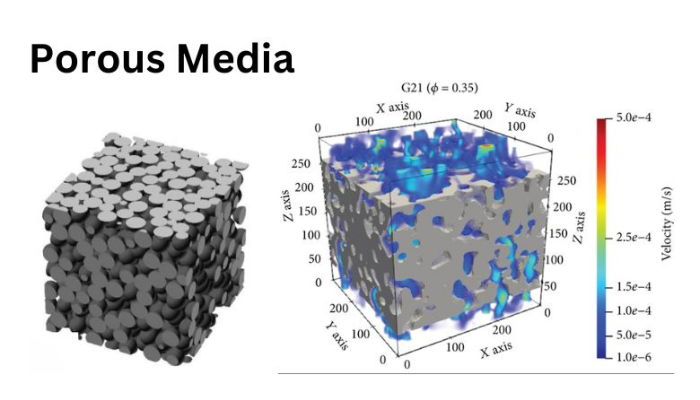
It is simply the flow of fluid through a porous medium. Porous media are materials that contain voids or pores through which the fluid can move. And this flow depends on the properties of that fluid. It contains porosity, permeability, and the viscosity of that fluid.
Principles of the Porous Media Flow with Ansys FEA
Here is Darcy’s Law. It describes the relationship between the pressure gradient & fluid velocity in low-speed flow.
Fluid motion only defines the porous flow of it. But what about the structure of the material by which it flows? That structure also matters. And here the Ansys FEA (Finite Element Analysis) complements the CFD by analysing the stress, strain & deformation in porous materials under the pressure or the thermal loads.
For instance, in environmental engineering, understanding how contaminants travel through soil helps in designing effective remediation systems.
Just have an example of a filter. Simulating a filter’s response under high fluid pressure ensures structural integrity. Engineers who are pursuing an Ansys Fluent CFD can gain the expertise to couple the structural & flow simulations. As this is an essential skill for multi-physics projects in aerospace, energy & automotive design.
How to Model the Porous Media Flow in Ansys Fluent
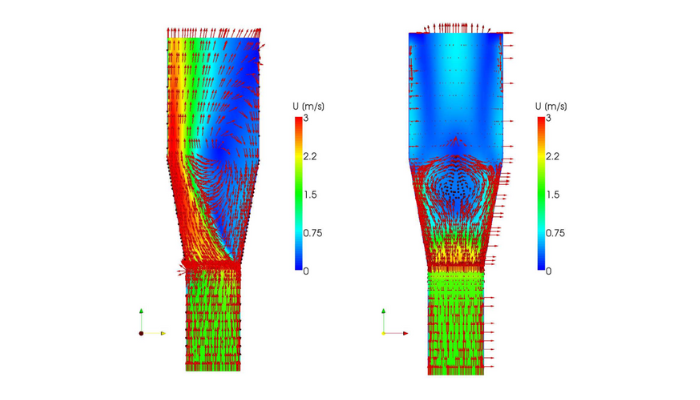
Ansys Fluent simplifies porous media simulations through an intuitive workflow in Ansys Workbench.
The general process of modelling porous media flow is as follows:
1. Geometry Setup: It defines the solid & fluid zones of the porous medium.
2. Meshing: Here, the grid is generated. That grid will be fine enough to capture the pore-level flow pattern.
3. Material Definition: Here, porosity & permeability are assigned to the porous zone.
4. Boundary Conditions: Realistic inlet/outlet pressures & flow rates are applied.
5. Solver Setup: Choose the laminar or turbulent flow models as per the Reynolds number.
6. Post-Processing: Visualise pressure drop, velocity distribution & heat transfer.
Professionals can upskill themselves with these skills through an Ansys Fluent online training or a specialised Ansys Fluent training designed for CFD applications.
Importance of Ansys Training for Effective Simulations

It requires a deep understanding of the advanced simulation tools to use them effectively. And with the comprehensive Ansys Fluent training, engineers are prepared enough to handle the complex porous media. From the initial setting up stage to interpreting the result accurately.
According to the internal survey of Ansys, trained professional users can achieve up to 40% faster project turnaround & significantly improve the model accuracy as compared to the self-taught users.
The Real World Applications of Porous Media Flow
Porous media flow is useful in multiple sectors:
- Environmental Engineering: used to predict the groundwater & contaminant flow.
- Chemical Engineering: Catalyst bed & filtration efficiency design.
- Biochemical Engineering: Simulation of the drug diffusion in tissues.
- Energy Systems: Used to enhance the oil recovery & thermal storage systems.
Conclusion
To understand & model the porous media flow is very important for the optimization of the designs & to ensure the operational reliability. Tools like Ansys Fluent help to empower engineers to simulate complex scenarios with accuracy. While Ansys Fluent training, Ansys Fluent online course & Ansys Fluent CFD programs help professionals to apply these tools effectively.
And in today’s simulation-driven world, mastering the porous media flow through the structured Ansys Fluent CFD online course is not only an upgrade. It is a competitive advantage.
Contact us today to get started!